
Let's talk about cat poop!

Healthy Poop in Cats

How often should a cat 'go'?

The general rule of thumb is that a cat should poop at least once a day. However, the frequency of your cat's bowel movements is affected by multiple factors including the age (i.e. kittens defecate more often than adults), diet, exercise, and health status (i.e. IBD, hyperthyroidism, parasites, CKD).

Because of this, the exact frequency of the bowel movement will be individual, and you should monitor for its fluctuations instead. If your cat's bowel movements start to differ from the normal frequency for longer than a day or two, it is advisable to pay a visit to the vet and resolve the cause of the change.

What does healthy poop look like?

Healthy cat poop should be deep brown in color (but not too dark nor black) and malleable in consistency (similar to modeling clay; it should be firm enough to leave little to no residue on the ground when picked up, yet pliable and not too hard). Poop should be passed in one piece or a few smaller pieces of somewhat cylindrical shape and segmented appearance. The odor shouldn't be too foul, although this can be variable.

Unhealthy Poop in Cats

The key signs to look out for in your cat's poop are the consistency, shape and color. The stool's consistency is directly influenced by the amount of moisture in it, which gives you an insight into the colonic health. The colon (or the large intestine) reabsorbs the remaining water and other key nutrients from the indigestible material, thus solidifying this material into the firm stool. The consistency of the stool can be descriptively scored to help you recognize if your cat's stool is healthy.

A comprehensive fecal scoring guide was described by Purina. According to Purina's guide, the consistency of the healthy stool can be scored on the scale from 1 to 7. The healthy stool (as described above) is scored with 2, while the stool that is too hard and dry is scored with 1. Scores from 3 to 7 are reserved for moist, mushy or liquid stools.

Hard stool (score 1) is typically a sign of constipation, which can be associated with dehydration, colon obstruction or certain metabolic and neurological conditions. Thus, if you notice that your cat is passing poop that is too hard in consistency, you should pay a visit to the vet and address the issue. The hard poop is passed in smaller, more spherical pellets which leave no residue on the ground, and the passing itself requires more effort.

Soft, mushy or liquid stools (scores 3-7) can be a sign of bacterial infections, intestinal parasites, or food intolerance. If your cat's poop is moist on the surface, thus leaving residue on the ground, but retains the shape and form when picked up, then its consistency can be scored with 3. This poop has little to no visible segmentation, but is not considered to be an alarming sign.

If the poop is so moist that it feels saggy and it loses form when picked up (but does retain a logged shape when passed), then the consistency can be scored with 4. Furthermore, if the stool is passed in a pile rather than the logs, then it is scored with 5. If your cat passes liquid stool with texture but no shape, then the consistency is scored with 6. Liquid stool without any texture nor shape is scored with 7.

Soft or fluid stool (as described by the scores 4-7), accompanied by a more frequent bowel movement, are referred to as diarrhea. While the causes for diarrhea are variable and often multi-factorial, this state is considered to be an important, sign of underlying problems and is a legitimate reason to consult with your vet. Sometimes, diarrhea can be caused by stress (i.e. moving to a new environment or bringing in a new pet), or food allergies and intolerance.

Other times, however, diarrhea can be a symptom of a disease, a bacterial infection, or even intestinal parasites. If your cat is suffering from diarrhea, make sure to closely monitor the frequency on your cat's bowel movement, so you can report it to your veterinarian. Keep an eye on other signs of disease and injury and the changes in your cat's behavior. This will be key for the diagnosis of the underlying cause.

Contact your veterinarian ASAP after spotting the symptoms, especially if diarrhea persists for more than two days and is accompanied by lack of appetite, lethargy, or vomiting. The veterinarian will diagnose the underlying cause and help you design a special recovery diet for your cat until it recovers.

The stool is a direct insight into its colonic health. It can help you recognize if your cat is eating the right diet and drinking enough water or if it's suffering from certain health problems. So, the next time you clean the litter box, make sure to quickly inspect if your cat's poop is healthy! A healthy cat is a happy cat.


Hear From Us Again

Don't forget to subscribe to our email newsletter for more recipes, articles, and clinic updates delivered straight to your e-mail inbox.

Related Categories:

cat health

Feline Dental Health: Top 10 Questions and Answers

It’s not all too common for cat owners to come in on account of their cat’s mouths. We have theories why.

Cat guardians have less direct contact with their pet’s mouth through chew toys and bouts of tug-of-war (as if a cat could be bothered).

The fact that poking around a cat’s mouth often results in deep puncture wounds (ouch).

Take your pick, add your own, but the majority of cat owners seem largely uninterested in the teeth, gums, lips, and tongue of their feline friend. But when they do ask questions, they’re some of the best, most challenging and interesting inquiries you’ll encounter. Read on; you just may learn something or get a chuckle or two.

1. How many teeth do cats have? I only see two – the fangs.

Cats have 30 adult teeth and 26 baby teeth. That’s far fewer than dogs (42 and 28) and less than humans (32 and 20). Those “fangs” or upper canine teeth often protrude saber-tooth tiger style and lend some cats an intimidating smile.

2. When do cats get their baby and adult teeth?

Observing the eruption or emergence of teeth is a great method for estimating a kitten’s age. This is particularly helpful when faced with a stray kitten. The first teeth to erupt are the tiny front teeth or incisors and the long, pointy canines (“fangs”). The primary (or “baby”) incisors and canines become visible around three to four weeks of age. The teeth immediately behind the canines, the premolars, quickly follow the front teeth. This typically occurs when the kittens are around five to six weeks old. The permanent teeth erupt around 11 to 16 weeks of age, beginning with the incisors followed by the canines at 12 to 20 weeks. The premolars are in place by 16 to 20 weeks of age. The difficult-to-see, way-in-the-back molars emerge around 20 to 24 weeks.

3. Do cats get cavities?

Dental caries, or “cavities”, are rare in cats and dogs. This is due in part to a cat’s relatively low-sugar diet, differences in oral bacteria, and the shape of the teeth. When cavities occur, they can be painful and require similar repair procedures as humans with cavities.

4. Why are cat bites so bad and likely to get infected?

Anyone who’s worked with and handled enough cats knows that when you’re bitten (note the “when”) by a cat, not only does it hurt, but those deep puncture wounds are likely to become infected or abscessed. The first answer lies within the unique anatomy of one of a cat’s main weapons – those long, sharp, pointy canines. Designed similar to hypodermic needles, these teeth excel at penetrating flesh intensely, damaging underlying structures such as arteries and veins. In addition, like that needle, they carry pathogenic bacteria deep inside the body. As the tooth is withdrawn, the narrow puncture wound closes onto itself, trapping behind infection that later becomes an abscess. Making matters worse, a cat’s mouth contains several species of highly pathogenic microorganisms. Don’t take a chance if you’re bitten. Flush the wound thoroughly and seek medical attention.

5. Can cats re-grow their teeth? Do their teeth keep growing their entire lives?

No and no. Sharks are probably the animal you’re thinking of. After a cat gets all 30 permanent teeth in place, that’s it. No more. Lose one and your cat is forever down to 29. Unlike rodents, a cat’s teeth don’t keep on growing.

6. Do cats need braces?

You jest but some cats do, in fact, need braces to correct some very severe oral malformations. The most common reasons for feline brace-face include lance or saber-like canine projections of the upper canines in Persian cats. “Wry bite” is another problem that results when an uneven bite occurs, causing one or both canines to protrude at odd angles, preventing normal eating and drinking. Braces for cats aren’t for cosmetic but literally life-saving conditions.

7. My vet said my cat had some painful tooth problem that may require extraction of several teeth. Is this legit?

Your cat may be one of the millions of cats affected by an unusual, exceptionally common and extremely painful condition known most often as feline ondoclastic resorptive lesions, or FORLs. Most cats with FORLs are over five years old. The most common clinical signs associated with FORLs include excessive salivation, bleeding from the gum line or teeth, and difficulty eating. Cats will suddenly become “picky” and refuse to eat dry kibble. There are many treatments available, but extraction is still the most commonly performed procedure to relieve this excruciating condition. The exact cause of FORLs has yet to be determined, although researchers are actively pursuing several theories.

8. Can cats get mouth cancer?

Sadly, yes. Oral tumors in cats are very serious and require immediate and aggressive treatment. Squamous cell carcinomas (SCC) are the most common malignant oral tumor in cats, although many other forms of cancer occur. If you observe any lumps, swelling, or discolored areas in your cats’ mouth, have it seen by your veterinarian at once.

9. My cat has swollen gums and entire mouth seems inflamed. What’s going on?

It’s likely your feline has a condition called stomatitis (more correctly referred to as lymphocytic plasmacytic gingivitis pharangitis syndrome). This condition is also very painful and most cats have problems eating and swallowing, weight loss, and excessive salivation. Treatments vary widely and cats respond differently to an assortment of options. The exact cause is unknown although an underlying immune-mediated disorder is strongly suspected. Be patient and work closely with your veterinarian; cats with stomatitis require extended periods of treatment.

10. I can’t brush my cat’s teeth! Am I a bad pet parent?

If not brushing your cat’s teeth is your worst offense, you’re not the worst. Fear not, you can choose to opt for routine cleaning (typically at least once a year) under anesthesia by your veterinarian. While they are sleeping, your vet may take dental x-rays to ensure there are no hidden problems underneath the gums. You can also give them chew treats approved by the Veterinary Oral Health Council (VOHC) to help reduce tartar in cats.

If your cats can tolerate it, try an oral antimicrobial rinse so they get their “mouth wash” a few times each week. Finally, make it a habit to (carefully) lift the lips of your cat and examine their teeth and gums each week to make sure everything looks healthy. So don’t fret— take your cats to your veterinarian at least once a year, have the teeth cleaned by a professional when needed, conduct routine home mouth checks, and use products proven to help keep your kitty’s mouth healthy.

If you have any questions or concerns, you should always visit or call your veterinarian – they are your best resource to ensure the health and well-being of your pets.


Hear From Us Again

Form Block
This form needs a storage option. Double-click here to edit this form, and tell us where to save form submissions in the Storage tab. Learn more

Don't forget to subscribe to our email newsletter for more recipes, articles, and clinic updates delivered straight to your e-mail inbox.

Related Categories:

dog health

Why Do Some Cats Eat Plastic?

It’s in a cat’s nature to chew, but chewing on plastic can be dangerous.

Many cats find joy in non-toy objects. We have all probably heard that cats love to play in paper bags, and if you are reading this, you have undoubtedly seen photos shared on social media sites with cats curled up in cardboard boxes. A bit less predictable and a little more esoteric, however: eating plastic.

The real danger here is many cats end up eating the plastic and getting blocked along their GI tract, requiring surgery. If your cat does eat any plastic, we would recommend taking this behavior seriously and attempting to address it quickly.

Cat’s Drive for Plastic: A Compulsive Disorder?

You may be familiar with the medical term pica: the eating of non-food objects.

Sometimes it is believed the pet is attempting to fill a nutritional void, but in cases where the pet relentlessly seeks one particular type of object, it may be an obsession and not a nutrition deficit. Pica in cats can be caused by a number of conditions, including gut disease, feline leukemia virus (FeLV), feline immunodeficiency virus (FIV), anemia, obsessive compulsive disorder, dental disease, and hyperthyroidism to name a few. A vet visit is always a wise place to start.

Eating plastic doesn’t automatically qualify as a compulsive behavior in some cats because they seem to like the way the plastic tastes or feels more than that they “need” to be doing this. For this reason, jumping to behavior-modifying drugs is not typically recommending for cats that seem to be strongly driven to explore and chew specific tastes and textures.

If your veterinarian explores the potential cause for plastic-seeking behavior and believes it points to a compulsive disorder, behavior-modifying drugs such as fluoxetine (generic Prozac) may be a consideration.

Non-Medical Therapy for Plastic Eating Cats

Providing multiple opportunities for hunting and play games, cat manipulation toys with food stuffed inside for foraging and eating, feeding both canned food and unique orally stimulating food, and offering dog chew toys as an alternative may help. Chew items such as rawhide chews, Nylabones, cat grass, and softer dead animal parts that are available as chews for dogs (e.g. lambs’ ears) can help. Make sure that there is also adequate aerobic play to keep the inquisitive cat busy and reward-based training to help satiate intelligent cats.

Ultimately, if the problem continues, the most extremely-affected plastic-seeking cats may need to be confined or housed in a cat-proofed room at times when supervision is not possible to protect them from foreign object ingestion.

Some cats just like to eat plastic. Cats have liked stranger things; bleach? New shoes? Your hair?

Has your cat ever eaten something strange? Leave us a comment below.


Hear From Us Again

Don't forget to subscribe to our email newsletter for more recipes, articles, and clinic updates delivered straight to your e-mail inbox.

Related Categories:

cat health

7 Ways to Make the Holidays Safer for Pets: Holiday Pet Safety Crash Course

​Nothing can spoil holiday cheer like an emergency visit to a veterinary clinic. These seven tips can help prevent a holiday disaster with your pets.

7 Ways to Make The Holidays Safer for Pets

  1. Keep people food out of the reach of your pet, and ask your guests to do the same.

  2. Make sure your pet doesn't have any access to treats, especially those containing chocolate, xylitol, grapes/raisins, onions or other toxic foods.

  3. Don't leave your pet alone in the room with lit candles, a decorated tree or potpourri.

  4. Keep holiday plants (especially holly, mistletoe and lillies) out of reach of pets.

  5. Consider leaving the tinsel off your tree if you have a cat.

  6. Secure your Christmas tree to keep it from falling over if your dog bumps it or your cat climbs it. Hanging lemon-scented car air fresheners in the tree may deter your cat from climbing it.

  7. Provide a safe place for your pet to escape the excitement (such as a kennel, crate, perching place, scratching post shelf or hiding place) if you’re entertaining guests. If your pet is excitable or scared, consider putting your pet in another room with some toys and a comfortable bed.

Plan in advance

Make sure you know how to get to your 24/7 emergency veterinary clinic before there's an emergency. Talk with your veterinarian in advance to find out where you would need to take your pet, and plan your travel route so you're not trying to find your way when stressed. Always keep these numbers posted in an easy-to-find location in case of emergencies:

  • Your veterinarian's clinic phone number

  • 24/7 emergency veterinary clinic

  • ASPCA Poison Control Hotline: 1-888-426-4435 (A fee may apply.)

If you’re a client of ours at River Landings Animal Clinic, additional numbers to make note of are:

  • Animal ER - (941) 355-2884

  • Vet Care Express Animal Ambulance - (941) 592-5131

  • 24/7 Pet Poison Control Center - (855) 764-7661


Hear From Us Again

Don't forget to subscribe to our email newsletter for more recipes, articles, and clinic updates delivered straight to your e-mail inbox.

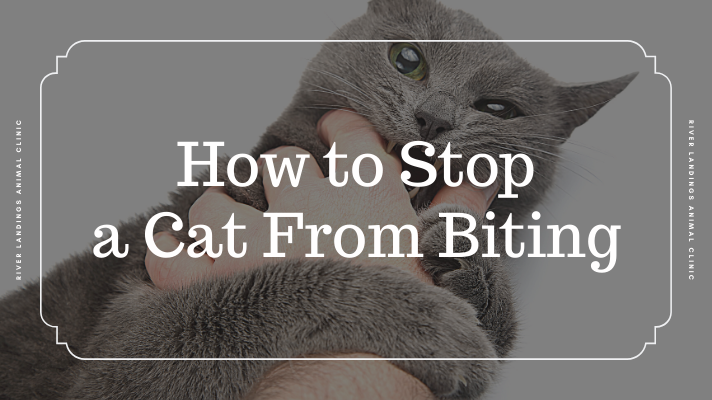
How to Stop a Cat From Biting

When you think of a cat, your initial image may be of a soft, peaceful animal purring quietly in your lap like a little furry engine of contentment. Unfortunately though, cats can pack a painful bite. Hopefully your cat keeps to biting only toys and food, but if your cat starts biting you, there’s usually a reason for it.

Why Do Cats Bite?

Cats need daily predatory play, which includes the opportunity to grab, pounce, and sink their teeth into something to simulate killing. A happy cat is one that thinks they've killed something every day. Because of this, movement triggers a predatory instinct and can cause a cat to pounce on an ankle or foot.

Another common reason cats bite is that the behavior was unintentionally reinforced when they were kittens. When cats are kittens, their job is to sharpen their hunting skills. Those skills include movements called the “pounce and bite” and the “grab and bite.” To practice those skills, a kitten needs something to bite, and it shouldn’t be your hand. While a kitten’s nip may not draw blood, their teeth will get bigger and their jaws will get stronger. If cats don’t learn that it’s inappropriate to bite people while playing as kittens, it’s only natural they’ll keep biting as cats.

While cats are very expressive creatures, they can’t come right out and tell you in that they’ve got a toothache or that arthritis is making their back hurt, so their biting could also be a way of letting you know there’s a medical issue. Cats are very good at hiding when they’re in pain, so when they finally do bite, things may have gotten pretty painful. If your cat suddenly starts biting you, take them to a vet.

Some cats also bite because of something called redirected aggression, which can occur in humans too. A human may have a bad day at work then come home and yell at their wife, while a cat may see another cat outside through the window, which can be very upsetting to them, and they take it out on whoever’s near them.

Owners are likely to describe it as biting out of the blue as they had not seen the episode that originally upset the cat, only the cat’s delayed reaction to it. If your cat does bite, take the wound seriously. More than with dog bites, the bacteria in cats’ mouths can lead to difficult-to-treat infections.


How to Stop a Cat from Biting (And Train a Kitten Not to)

If your vet has ruled out any medical explanation for biting, make sure your cat has a daily outlet for predatory playing. Every human should play with their cat for ten minutes every day with a feather or cat nip toy so they can ‘kill’ it". This daily play therapy will let your cat express that innate drive to kill.

Experts agree that playing appropriately with kittens using toys will help prevent them from biting people as adult cats. Kittens will naturally try to bite you while playing and when they do, don’t reprimand them, simply turn away and stop playing with them. This mimics what a mother cat would do if play got too aggressive. You’re teaching them social boundaries that if they play too hard, you’ll get up and walk away.


This action is a lot like giving your kitten a “time out,” as you might do with a child. The technique also works for adult cats, as they’ll quickly realize that if they bite, their favorite person (you) will disappear. Leave the room, if only for a few seconds, then return to your cat.

Don’t reprimand your cat by squirting it with water or using a shock mat, as those things may make the situation even worse.


Negative reinforcement may raise the anxiety level even more and cats remember things very well and they can link the bad experience, like being squirted with water—with you. They’ll think you are the one creating painful and awful things and act even more out of fear and aggression, or they’ll just hide from you all the time.

When a cat bites, they’ve often tried to warn the person they’ve bitten that they’re about to do so. You usually can tell that a cat is agitated by their body language. Behavior that says “back off” includes tail thrashing, pinned-back ears, dilated pupils, and hissing and growling. Hair standing up on their back and whiskers facing forward can also be signs of agitation.

If your cat bites you aggressively and your vet finds no pain trigger for the behavior, a veterinarian who specializes in feline behavior may try treating the cat with supplements, medication, a change in diet or a combination of all three. The treatment will hopefully reduce anxiety that may be causing your cat to bite, and then he or she can return to strictly chomping toys and treats — not people.


Hear From Us Again

Don't forget to subscribe to our email newsletter for more recipes, articles, and clinic updates delivered straight to your e-mail inbox.

Related Categories:
cat health